Showing posts with label conceptual literature. Show all posts

Tuesday, April 2, 2013

Darkness, 2012
We might have missed Yedda Morrison's interactive erasure exhibit, but we can get our very own copy of her full-length book Darkness (Make Now, 2012), an erasure of Joseph Conrad's Heart of Darkness (1899). A group of student responses to her work, other reviews and reactions here and here. My previous post with a link to Morrison's Chapter 1, here.
The 1950 Signet Classics edition of Conrad's Heart of Darkness

Wednesday, January 30, 2013


 HOLLY MELGARD
THE MAKING OF THE AMERICANS
TROLL THREAD 2012
PURCHASE | DOWNLOAD
Holly Melgard's The Making of the Americans (Troll Thread, 2012), in which she deletes all repeated words from her source text (Gertrude Stein's The Making of Americans (1925)). Melgard's work is viewable online here.

Melgard explains, "Poems can exploit what it is in books that makes texts appear as “text”; how their distributions and multiple frameworks of production may play a material role in their composure, their poetics. Like Gertrude Stein’s The Making of Americans, which gets called 'unreadable' because it’s super 'repetitive'.... NOW 'there is no such thing as repetition' in The Making of Americans, because I deleted it." 

Read more of Melgard's ideas over at Elective Affinities, here

Plus, it's listed (along with some other interesting and conceptual work) as one of the top poetry books of 2012 by MS Magazine! (Thanks, Harriet, for the link.) 

We can also purchase a physical copy of Melgard's work here.

Friday, January 11, 2013

from Karl LaRocca's Moby-Dick Compressed -- "An erasure of Moby-Dick removing every instance of a word following its initial appearance in the novel" in Issue 5 of The Agriculture Reader, here. "Larocca wrote a computer program that spat out the first words of every sentence in the novel, then he jammed on from there," they explain over at Electric Literature, here.

P.S. -- if you'd rather drink your books, you might try Rogue Brewery's White Whale Ale, infused with pages from Melville's novel.

Sunday, December 2, 2012


From Erica Baum's Dog Ear (Ugly Duckling Presse, 2011).

"I’m reauthoring the text in this simple act of folding the paper which creates a new view. I want the compositions to work both formally and linguistically on several levels simultaneously. It looks simple but it’s actually very hard to find ones where everything comes together. I think in order for concrete poetry to succeed it has to operate in both these ways. I’m also adding a third thing to this mix because these have to be found in a book. In this case the constraint is the page sequence....I’m looking for something that in some sense already exists and has the potential to yield something else," Baum says about her project, here.

Some discussion here and here, more images here and here, and many more links on the UDP page, here.

Friday, November 9, 2012


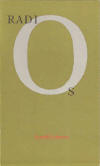
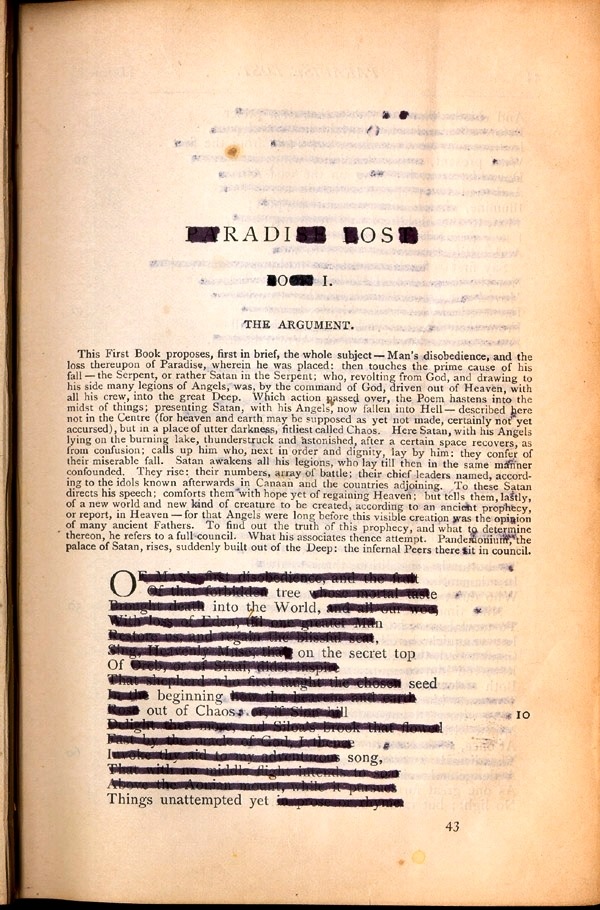
Ronald Johnson's radi os (Flood Editions 2005, Sand Dollar Press 1977), an erasure of the first four books of Milton's Paradise Lost. Johnson explains, "It uses an 1892 edition in which I omit most of the text to create a Blakeian visual page and a new Orphic text of my own," here
About Johnson and the book-making process here. (I got the above altered page image from Johnson's copy of Paradise Lost here.) Some reviews here, here, here, and (if you have access to J-STOR) here.

Wednesday, October 24, 2012

 Chris Piuma's The Constellated Sonnets (self-published 1995). The work, he explains, is "a series of 150 poems in which all the words in each line but one are erased from Shakespeare's sonnets. The punctuation, as you'll see, is left behind," and "I randomly selected the words. (Rolling a d10; if a 6 came up, using the sixth word, and if there was no sixth word in that line, rerolling," on his blog. Here's his Sonnet 18 ("Shall I Compare Thee to a Summer's Day"):
And, we can read the entire project in .pdf form, here.

Thursday, October 4, 2012


1) From the ongoing project "Plagiarizing Poetry Magazine."  The author AMF explains "This project is to explore the meaning of the word plagiarism," and  "My project hopes to push Poetry magazine and its readers into a discussion about artistic thought, ownership and originality, which can only take place now in our interconnected world," here. The complete blog, with more images and information is here.


2) The original cover of Poetry Magazine, April 2012. More about Poetry here


3) Also, the Winter 2012 issue of Abraham Lincoln.

Friday, July 6, 2012


Robert Fitterman's The Sun Also Also Rises: A Hemingway Reader (No Press, 2008?), a chapter-by-chapter conceptual response to Hemingway’s The Sun Also Rises. Fitterman explains, "I have erased my way through Hemingway's original text, leaving behind only the phrases that begin with the pronoun 'I'," here. Read an excerpt in .pdf here, and more (and more editions) here and here. Fitterman's website is here.

Thursday, June 28, 2012

A page from Abraham Avnisan's erasure project SIC: Deletions and Emendations (from Freud's The Interpretation of Dreams (Avon, 1967/1900)). Avnisan explains, "The constellation of Sic’s textual layers is open-ended: to make sense of it, the reader is invited to step into Freud’s shoes and interpret the texts and images for herself," here, where we can also see an excerpt of the text. Plus, two pages featured in Drunken Boat #15.

Thursday, December 29, 2011

Rosmarie Waldrop's Shorter American Memory (Paradigm Press, 1988/2001?), here and here, a collection of prose poems collaged from documents collected in Henry Beston's American Memory (1937). A sample poem,"Shorter American Memory of the Declaration of Independence," here, and some discussion here, here, and here.

Henry Beston's American Memory (Farrar & Rinehart, 1937)
Thursday, December 8, 2011

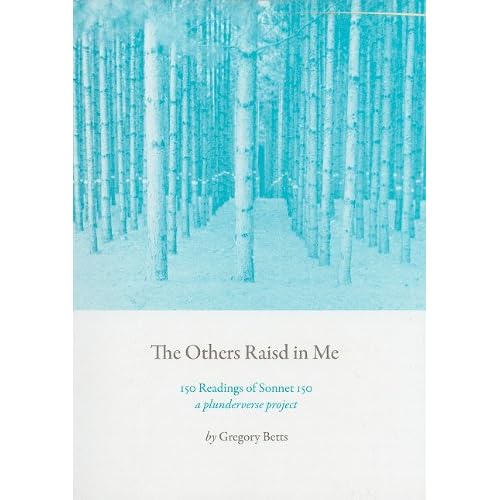
Gregory Betts' The Others Raisd in Me: 150 Readings of Sonnet 150 (Pedlar Press, 2009), 150 versions and permutations of Shakespeare's Sonnet #150. "The work examines ideas of selfhood from the 17th century into the present, flirting with a cyborgian future," here. Susan Holbrook describes the project as "push and pull, the simultaneity of inflation and infolding, spill and vacuum, all performing between the covers of a book which is itself both smaller and bigger than your standard poetry collection" here. More here. Betts' "plunderverse" project, here. More discussion & examples here, here, here, and here; more about Betts here.
See also this version by Trainwreck Press, here, and--of course--other Shakespearean experiments here.

Wednesday, September 28, 2011

Just out! Elizabeth Robinson's book of poetry Three Novels (Omnidawn 2011), which "recasts three mysterious novels into poetic prose fragments." The three novels Robinson are Wilkie Collins's The Woman in White (1860) and The Moonstone (1868), and George Gissing's Eve's Ransom (1895).

Robinson explains, "I wanted to make distinct formal decisions in shaping these poems so that the particularities of the books would be more evident. [For example,] The Moonstone is said to be the first detective novel and so, in the poem of the same name, I wanted to alternate quasi-prose blocks that had a kind of prose-like orderliness with more open passages that addressed what I saw as the affective undercurrent of the book" in an interview here. Excerpts here and here, and more info here. An review here, and an interview with Robinson here.

Thursday, March 24, 2011


page 23 of Zak Smith's Pictures Showing What Happens on Each Page of Thomas Pynchon's Novel Gravity's Rainbow (Tin House Books, 2006), here. Some discussion here, here, here. Smith explains, I tried to illustrate the passages as literally as possible--if the book says there was a green Spitfire, I drew a green Spitfire." Smith's website (with images), here.

and: page 197 from Matt Kish's One Drawing for Every Page of Moby Dick. Coming soon from Tin House, here. His blog here and more images here. A short review here. Plus, Oprah likes it!

Monday, March 7, 2011

Derek Beaulieu's Local Colour (ntamo 2008), a "page–by–page interpretation of Paul Auster’s 72–page novella Ghosts.... Beaulieu has removed the entirety of Auster’s text, leaving only chromatic words—proper nouns or not—spread across the page as dollops of paint on a palette," according to his website. More images here and here. Some discussion here. A free .pdf of the entire book here.

Paul Auster's Ghosts (Penguin, 1986)

Against Expression: An Anthology of Conceptual Writing, edited by Craig Dworkin & Kenneth Goldsmith (Northwestern UP, 2011). An interview w/Dworkin here. The table of contents, and some info, here.

Monday, November 8, 2010

Shall we compare Vanessa Place's tweeting of the entirety of Gone with the Wind with Elevator Repair Service's play Gatz, "not a retelling of the Gatsby story but an enactment of the novel itself. Over the course of 6 1/2 hours, Fitzgerald’s American masterpiece is delivered word for word, startlingly brought to life by a low-rent office staff in the midst of their inscrutable business operations" and/or Getting Inside Jack Kerouac's Head, a backwards-blogging (by Simon Morris) of on On the Road ?
(Vanessa Place talks conceptual writing here. )

Maybe. But I like books better.