Showing posts with label poetry. Show all posts

Monday, June 13, 2016

Jill Maji's Labor (Nightboat, 2012)
Jill Magi describes her book LABOR (Nightboat, 2012) as "A fiction ... / An installation / A handmade employee handbook." But, of course, it's also A Poetry. Read more about LABOR, and see more images of the author's text and text-work on Magi's site, here.

Find excerpted poems from LABOR at jubilat, here; and at The Brooklyn Rail, here. Read reviews at CSU's Center for Literary Publishing, here; at Tupelo Quarterly, here; and at Drunken Boat, here.

In an interview with Andy Fitch, Magi explains how, when drawing from source texts, such as those she found at the Tamiment Library & Robert F. Wagner Labor Archives (a public archive at NYU's Bobst Library), "[T]he words are openings into, portals into something generative, a story about to come." 
still from LABOR: Finding Guide
LABOR is a physical, not merely intellectual work; Magi reminds us, "I actually made boxes, lined them with fake fur, and put documents in them while I was writing LABOR."
 
Even more: view Magi's LABOR: Finding Guide on YouTube; read her curated chapbook Labor Poetic Labor! (Essay Press), online here; and, be sure to check out Magi's series on Textile Poetics at Jacket2.

Wednesday, April 6, 2016

The Place of Scraps (Talon Books, 2013)
Jordan Abel's The Place of Scraps (Talon Books, 2013), from Marius Barbeau's Totem Poles (1950)

Totem Poles, Vol. 1 (Ottawa: King's Printer,  1950)

The Place of Scraps "explores the complicated relationship between First Nations cultures and ethnography. [These] poems simultaneously illuminate Barbeau’s intentions and navigate the repercussions of the anthropologist’s actions." - explains Abel on his website.

Mercedes Eng explains, "Totem poles tell the history of a people. Like its source, Scraps deploys linguistic and visual systems of representation to record First Nations history but unlike its source, it reveals anthropology as a colonial weapon in its creative distillation of Barbeau’s ethnography." Read the rest of her consideration of The Place of Scraps at Jacket 2, here.

Read an interview on Lemonhound here, more about Abel's project here, here and here, watch Abel on YouTube here, visit his website here.

Wednesday, March 23, 2016

"Community Chest" cards are finished, but the "book" is still in progress -- here are some first (not quite right) attempts building at card case boxes for Community Chest.

Materials: cardstock, stamp, scoring board, scissors, double-sided tape.

Sunday, January 31, 2016

From "Community Chest,"* a work-in-progress. Ultimately (I think): 12 sets of 12 different cards, to be variously combined or singled out to create poems.

Materials: self-inking stamp, ionized paper. 

*with thanks to Mary Fitzpatrick for the title.  

Thursday, August 13, 2015


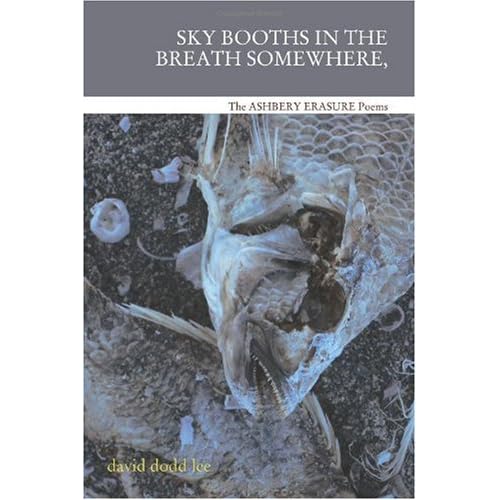
David Dodd Lee's Sky Booths in the Breath Somewhere: the Ashbery erasure poems (BlazeVOX, 2010).

"Most of the poems I chose to erase came out of three books from A’s middle period--Hotel Lautreamont, And the Stars Were Shining, and Flow Chart," Lee explains in a very thorough interview here; he goes on: "I will say I wasn’t trying to ruin Ashbery’s originals—it felt to me like I was simply trying to take advantage of A’s genius (he’s got plenty to spare) and make something wholly separate seeming (stress here on the word 'seeming')." More info and excerpts here. Reviews here and here.

Thursday, June 11, 2015

 "for locating the room" -- Study for Green Room (May 2015) -- a poem in progress.

 materials: "Martian Green" paper, typewriter, glue.

Monday, May 11, 2015

Still image from "Clevemark Dr.," a collaborative installation by Stephanie Ellis Schlaifer and Cheryl Wassenaar (fall 2014, St. Louis), based on Schlaifer's manuscript Clarkston Street Polaroids.

"The text, visually reinterpreted by Wassenaar in cut vinyl lettering, comes from Schlaifer's poems. Sculptural objects are covered in, made from, or altered by sugar, pickling salt, or soap," according to the artist's statement at Vimeo -- plus, "walk-through" the installation, which includes the poem "When the eye saw     it appeared," below (first published in Kestral (2011)). More images and discussion at the Fort Gondo site, here.


Monday, April 20, 2015


Study for "Green Room" (April 2015) -- a poem-in-progress. I'm interested in the way the lines / stanzas of the poem can be shifted and moved from one pocket to another, allowing the book (the poem-draft) to be read in different configurations and allowing me to see new ways for this poem to progress.

The form is "X-Book with pockets" (can be found on pages 33-34 in Alisa Golden's Making Handmade Books). 

Friday, March 20, 2015

From As We Know (Subito Press, 2014), a collaborative project by Andy Fitch and Amaranth Borsuk. As We Know "repositions erasure procedures at the origins of (rather than in response to) a published text. Here Amaranth Borsuk has taken Andy Fitch’s summer diary and reshaped 60 passages...into a new type of collective confessional/constructivist collage that brings her own voice into the text and foregrounds the tensions of authorship," according to the As We Know website.

See more images of the project at The Volta and Matter, discussion here, here and here, a conversation between Borsuk & Fitch here.

Sunday, June 8, 2014


From my own recent folded-poem project: 


"For the desperate song, the need in the night"


one star = one line of the poem

Monday, November 25, 2013


One of  Francesca Capone's Poem Weavings (undated). See more images here and here and here. Some discussion with Capone here.

Tuesday, April 2, 2013

Darkness, 2012
We might have missed Yedda Morrison's interactive erasure exhibit, but we can get our very own copy of her full-length book Darkness (Make Now, 2012), an erasure of Joseph Conrad's Heart of Darkness (1899). A group of student responses to her work, other reviews and reactions here and here. My previous post with a link to Morrison's Chapter 1, here.
The 1950 Signet Classics edition of Conrad's Heart of Darkness

Wednesday, February 27, 2013

The Next Big Thing


settings for these scenes (Convulsive Editions, 2013)
1. What is the working title of the book? 
settings for these scenes

2. Where did the idea come from for the book?
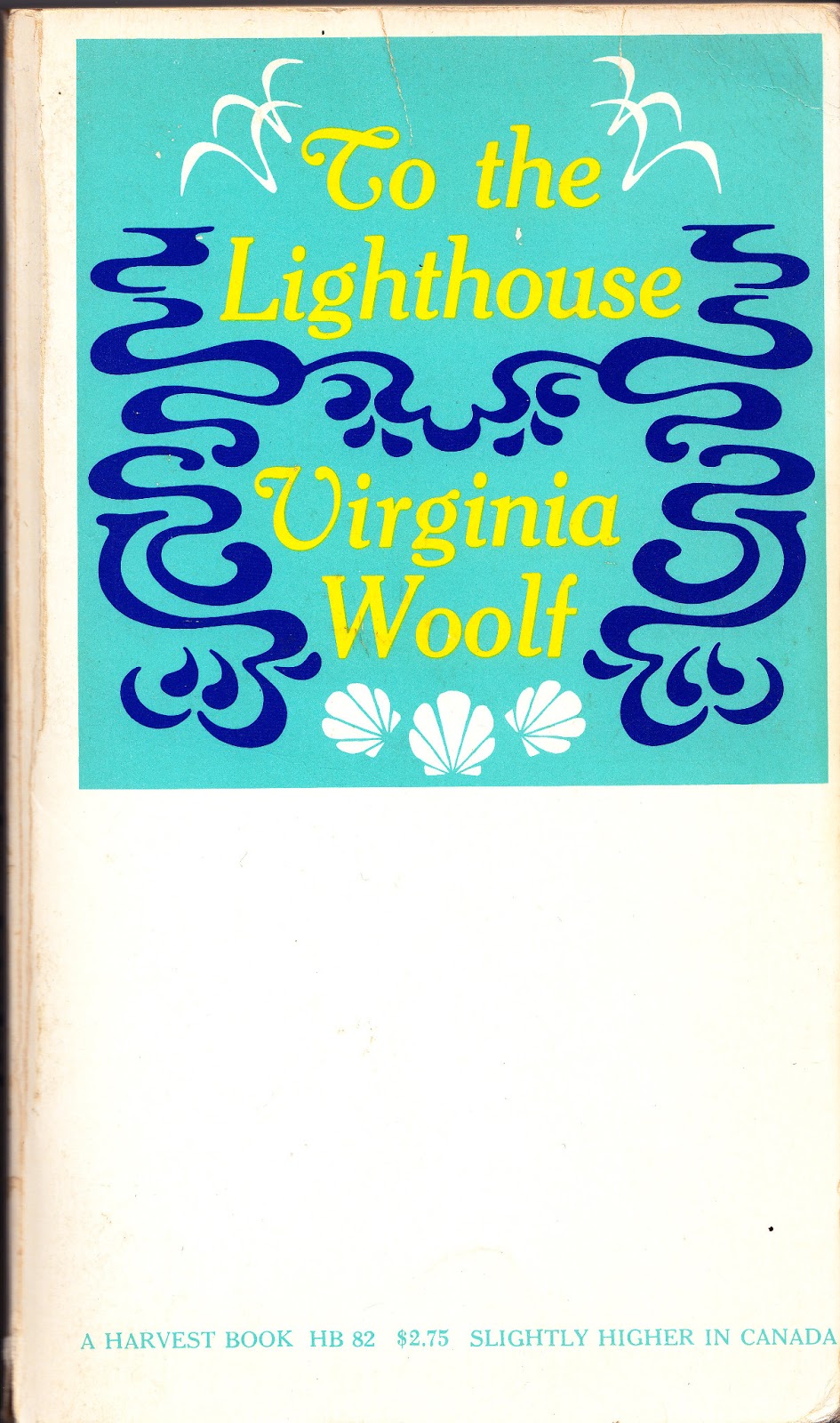
Literally, from Virginia Woolf’s To the Lighthouse (1927). The copy I used was published in 1955, and all the text in setting for these scenes is from a single paragraph of the novel. The paragraph begins: But whose foot was he thinking of, and in what garden did all this happen?
To the Lighthouse (Harvest Books, 1955)
3. What genre does your book fall under? 
Poetry, though it is carved from fiction. Also erasure, found poetry, appropriation, maybe conceptual writing.... 

4. What actors would you choose to play the part of your characters in a movie rendition?
Well, the wind is a character, and the light(s). There's a garden. It's tough to think of actors who could pull off just being shadow, or scenery. 

5. What is the one sentence synopsis of your book?
“these scenes were drawn, like a  leaf”

6. How long did it take you to write the first draft of the manuscript?
For this type of project, it's difficult to pin down what exactly a draft is. Maybe the selection of source text was one draft? That took a week or so, though I'd been circling around doing a project of this nature -- thinking I should perform some "legitimate" literary erasure to compliment my research into the form -- for some months and struggled a lot over potential source material.... But once I had an audience more firmly in mind (see #7), I was able to narrow my options and turn to Woolf. 

There are also multiple versions of the book. The first was a handbound nine-poem volume that I completed as a gift in 2011. But once I started carving out poems from Woolf's paragraph it became pretty addictive--it was exciting that the same language could be selected or manipulated into so many different sets. Like the best game of Boggle ever, really. I made over sixty erasures of Woolf's paragraph before telling myself that enough was enough. settings for these scenes includes 13 of these poems. I probably spent six months or so gathering these erasures. 

7. Who or what inspired you to write this book?
Certainly the literature I've been lucky enough to study as part of my dissertation has influenced this project -- you'd only need to skim through my blog to see the kind of work I've been paying attention to recently. Ken Campbell's artist book Father's Garden (1988), which I was lucky enough to see in person at The Getty library in 2009, has a structure of obscuring and delaying the experience of the poem, which I'm sure in some way inspired my choices in settings. Too, I really enjoy the permutative work Gregory Betts does in The Others Raisd in Me (2009) and Caroline Bergvall's varied repetitions in her long poem "Via (48 Dante Variations)" (2003?).

Trying to list sources of inspiration is, too, just an example of selective memory. It's probably relevant to admit that I've been practicing this type of composition for some time, pretty much since a high-school English teacher let us make cut-outs of magazine language in order to create a poem. settings for these scenes is not the first book that I haven’t written. A Margaret Atwood chapbook (circa ~2002, discussed further here) is likely a more direct precursor to this project. Too, a little Alice in Wonderland dos-a-dos cut-up that I made at USC, does similar work obscuring and revealing elements of Lewis Carroll's original prose, while book-ifying and poet-icising the source text.

Alice's Alphabet (2010)
To be even more specific about the beginnings of settings for these scenes, for Mother's Day 2011 my mom asked me to write her some poems. Since I dislike being told to write poems, and I had been thinking about performing such a project for some time, my solution was to not-write some poems for her and bind them into a little book. (I'd post a picture of the handmade 2011 settings, but I only made one. Hi, Mom!) Anyway, having an audience in mind made it easier to select a source text. My mom likes nature, and gardening, and rocks, among other things. Most text written on these subjects is so unliterary that excavating multiple poems--let alone a single poem--from the same chunk of text would be ugly and/or impossible. So I turned to literary passages, and when I thought of Woolf's awesome density of language, I knew I was onto something! So, I made the 2011 settings, and then I kept on with the project of repeated poetic excising, as I said in #6, until it almost started interfering with the other work I had to do.

8. What else about your book might pique the reader’s interest?
Nate and Nikki made beautiful letterpressed covers for this chapbook! I can't get enough of the alien-green repeating shells on the cover.

9. Will your book be self-published or represented by an agency?
Convulsive Editions will publish the book. Come to the reading in March at AWP and get your hands on a fresh copy! Or you can buy it on their website, of course. 
  
10. My tagged writers for next Wednesday are:
Bryan Hurt, Stephanie Schlaifer, Vanessa Hua, & Karen Greenbaum-Maya

Sunday, December 2, 2012


From Erica Baum's Dog Ear (Ugly Duckling Presse, 2011).

"I’m reauthoring the text in this simple act of folding the paper which creates a new view. I want the compositions to work both formally and linguistically on several levels simultaneously. It looks simple but it’s actually very hard to find ones where everything comes together. I think in order for concrete poetry to succeed it has to operate in both these ways. I’m also adding a third thing to this mix because these have to be found in a book. In this case the constraint is the page sequence....I’m looking for something that in some sense already exists and has the potential to yield something else," Baum says about her project, here.

Some discussion here and here, more images here and here, and many more links on the UDP page, here.

Friday, November 9, 2012


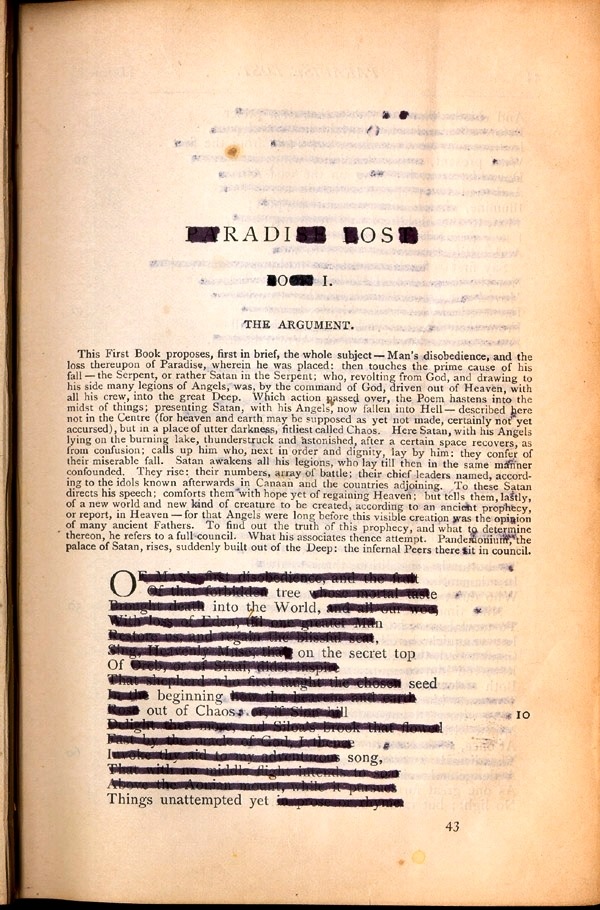
Ronald Johnson's radi os (Flood Editions 2005, Sand Dollar Press 1977), an erasure of the first four books of Milton's Paradise Lost. Johnson explains, "It uses an 1892 edition in which I omit most of the text to create a Blakeian visual page and a new Orphic text of my own," here
About Johnson and the book-making process here. (I got the above altered page image from Johnson's copy of Paradise Lost here.) Some reviews here, here, here, and (if you have access to J-STOR) here.

Wednesday, October 24, 2012

 Chris Piuma's The Constellated Sonnets (self-published 1995). The work, he explains, is "a series of 150 poems in which all the words in each line but one are erased from Shakespeare's sonnets. The punctuation, as you'll see, is left behind," and "I randomly selected the words. (Rolling a d10; if a 6 came up, using the sixth word, and if there was no sixth word in that line, rerolling," on his blog. Here's his Sonnet 18 ("Shall I Compare Thee to a Summer's Day"):
And, we can read the entire project in .pdf form, here.

Thursday, June 28, 2012

A page from Abraham Avnisan's erasure project SIC: Deletions and Emendations (from Freud's The Interpretation of Dreams (Avon, 1967/1900)). Avnisan explains, "The constellation of Sic’s textual layers is open-ended: to make sense of it, the reader is invited to step into Freud’s shoes and interpret the texts and images for herself," here, where we can also see an excerpt of the text. Plus, two pages featured in Drunken Boat #15.

Thursday, April 26, 2012


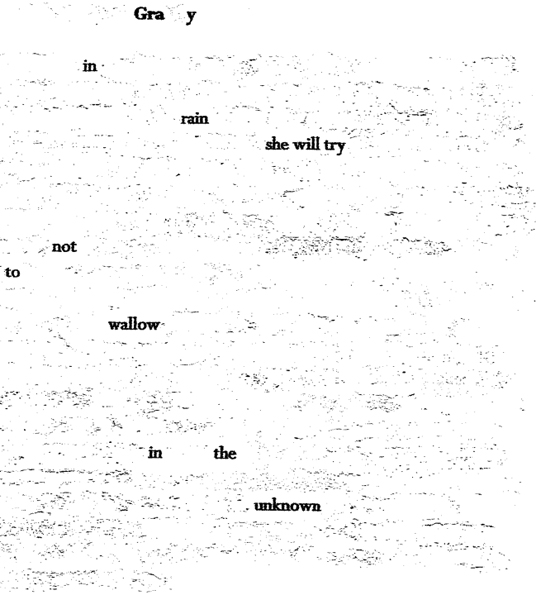
Bradley Harrison's "Gray," the last in a series of erasures of his own poem "Her Problem of Gravity" (2012). Read them all over at The Offending Adam, here. And, with other self-erasures (with white-out!) in his newly released volume Diorama of a People, Burning (Ricochet 2012), here.

Tuesday, April 10, 2012


Emily Dickinson's Poems (Little, Brown 1901). More here.

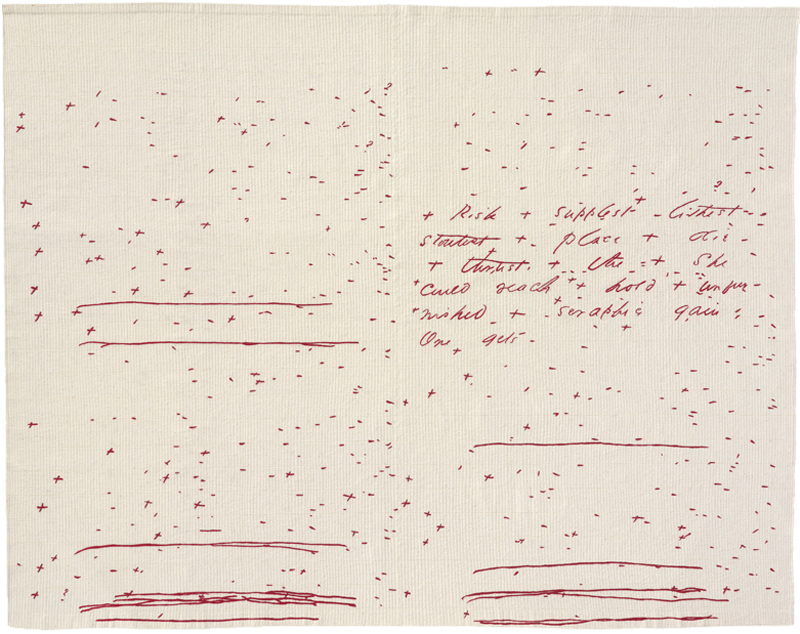
1) Janet Holmes THE MS OF M Y KIN (Shearsman, 2009), an erasure of Dickinson's Civil War poems, here. More pages here, Holmes discusses her project here, Ron Silliman discusses it here, and p. 98 is below:


2) Kiki Smith's Emily Dickinson Sampler (Arion Press, 2007) -- 200 of Dickinson's poems with prints by Smith. More here and here.

3) from Jen Bervin's The Dickinson Fascicles (2004-2006?). More here. Published as The Dickinson Composites (Granary Books 2010), here.

4) Roni Horn's When Dickinson Shut her Eyes--For Felix; No. 352 (1993), here. More here, here, and here.
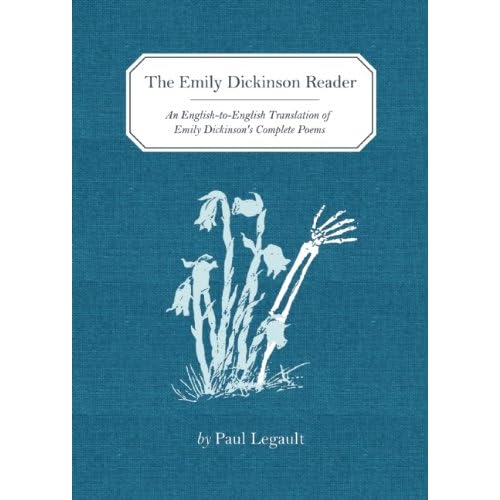
5) Paul Legault's English-to-English Translation of Emily Dickinson's Complete Poems (McSweeney's, 2012). Legault explains here, "The Dickinson translations are a joke that became serious—or at least became an extended joke that wasn’t over until I “translated” all 1789 of them into basic English." Watch the video here.

 6) See also Laura Wetherington's chapbook Dick Erasures (Red Ceilings Press 2011).

Wednesday, March 7, 2012


1) From Sean Bishop's RES--ECTIONS (from Darwin's 1859 The Origin of Species). Bishop explains, "I chose The Origin of Species mostly by accident....It was only after I'd begun erasing that I realized what I was doing: The process of natural selection is itself a form of erasure, after all," at iO: A Journal of New American Poetry, here, as part of a long interview about his chapbook-length erasure project. With more pictures, of course.
2). Ian Monroe's The _____ of _____ By Means of Natural _____ or the _____ of Favoured _____ In The Struggle For Life (2011, a free downloadable e-book, here). Monroe explains, "For the first time, Darwin's dangerous ideas have been published, with every word which doesn't occur in the King James version of the Holy Bible safely redacted."

I begin each page by boxing out interesting pieces of diction or syntax in pencil, then constructing an idea or story from those pieces and whiting out the rest.
I chose The Origin of Species mostly by accident, just because I had an old and beautiful edition of the book gathering dust on my shelf. It was only after I’d begun erasing that I realized what I was doing: The process of natural selection is itself a form of erasure, after all.