Showing posts with label altered book. Show all posts

Sunday, February 15, 2015

the ‘Infinite Jest Project’ by Corrie Baldauf (photo by PD Rearick)


1) An image from Corrie Baldauf's Infinite Jest Project, flagging all the colors in David Foster Wallace's novel Infinite Jest (Little Brown, 1996). "'It started as a tool, which is how someone would start drinking coffee or doing cocaine,' Baldauf says at Hyperallergic. 'But once the tool resolved the problem of not reading it, that was when it became an obsession.'" See more photos of the project on Baldauf's site, and read more here and here.

Infinite Jest p. 215 "Canadians"

2) From Jenni B. Baker's ongoing erasure project Erasing Infinite, here. "I only work with one page at a time. I scan each of the pages in as a JPG, which I open up in Photoshop and look at independently without the context of the pages that come before or after," Baker explains in an interview. Read more at HuffPost, here, and see images on Baker's site, here.

P.S. Baker is the founder of The Found Poetry Review -- take a peek.


The Infinite Atlas Project

3) The Infinite Atlas Project (2012- ), "an independent research and art project seeking to identify, place and describe every possible location in David Foster Wallace's Infinite Jest." Check out their site!

Sunday, October 5, 2014

E. M. M.'s  A Little White Shadow (Brown & Gross, 1889) 
&
Mary Ruefle's A Little White Shadow (Wave, 2006)

"A Little White Shadow, it turns out, is a book replicating—and containing—another book.... E.M.M. is Emily Malbone Morgan, a writer and philanthropist who wrote and self-published the novella A Little White Shadow, a Christian-themed inspirational tale of a young heiress summering in Italy, to raise money 'for the Benefit of a Summer Home / for Working Girls.'"

      —read the rest of my essay '"Destroying' the Text to Create the Poem" over at Post45. More images of Ruefle's work are here and here. Also, check out Mary Hickman's essay "Defaced/Refaced Books: the Erasure Practices of Mary Ruefle and Jen Bervin" over at Jacket2, here.


Sunday, April 20, 2014

Wednesday, August 21, 2013


John Eric Broaddus's High Time (1986). "I had no qualms about eliminating the entire text," Broaddus explains here. View more of his work here, here, and here; watch Johanna Drucker discussing his work here, a list of exhibitions here.

Friday, July 19, 2013

Susan Porteous's The Essential Gandhi (Green Bird Press 2012). "By finding books written about Gandhi and systematically spinning each page to make a continuous paper thread, the record of his life become intertwined with the spinning process. Each spun book is wound onto an antique spool of the appropriate size and the title of each work is appropriated from the book used in its creation," she explains here. More on her website, here.

The Essential Gandhi (Vintage Books 1962, 2002)

Thursday, April 18, 2013

Ros Rixon's "Violence in the Art," which looks to be from John Fraser's Violence in the Arts (Cambridge UP, 1974). "I am often asked if I think of the idea before I find a book or the other way around? I tend to work both ways," Rixon explains. More altered books and sculptures on her site, here

Sunday, December 2, 2012


From Erica Baum's Dog Ear (Ugly Duckling Presse, 2011).

"I’m reauthoring the text in this simple act of folding the paper which creates a new view. I want the compositions to work both formally and linguistically on several levels simultaneously. It looks simple but it’s actually very hard to find ones where everything comes together. I think in order for concrete poetry to succeed it has to operate in both these ways. I’m also adding a third thing to this mix because these have to be found in a book. In this case the constraint is the page sequence....I’m looking for something that in some sense already exists and has the potential to yield something else," Baum says about her project, here.

Some discussion here and here, more images here and here, and many more links on the UDP page, here.

Friday, November 9, 2012


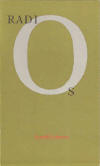
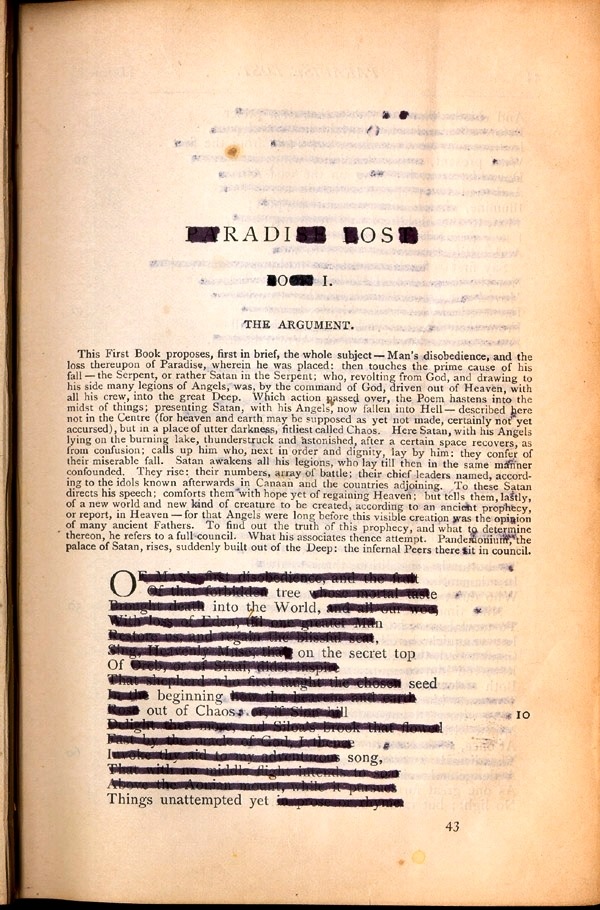
Ronald Johnson's radi os (Flood Editions 2005, Sand Dollar Press 1977), an erasure of the first four books of Milton's Paradise Lost. Johnson explains, "It uses an 1892 edition in which I omit most of the text to create a Blakeian visual page and a new Orphic text of my own," here
About Johnson and the book-making process here. (I got the above altered page image from Johnson's copy of Paradise Lost here.) Some reviews here, here, here, and (if you have access to J-STOR) here.

Monday, September 10, 2012


James Yeary's Untitled for Sachiko M (2010) from Samuel Beckett's The Unnameable (1953). "[T]he artist has transformed a copy of Beckett’s The Unnameable by highlighting all but the white breaths between sentences;" more images and information at Portland's 23 Sandy Gallery, here. More of James Yeary's books/arts/poems here, here, and here.

Thursday, June 28, 2012

A page from Abraham Avnisan's erasure project SIC: Deletions and Emendations (from Freud's The Interpretation of Dreams (Avon, 1967/1900)). Avnisan explains, "The constellation of Sic’s textual layers is open-ended: to make sense of it, the reader is invited to step into Freud’s shoes and interpret the texts and images for herself," here, where we can also see an excerpt of the text. Plus, two pages featured in Drunken Boat #15.

Wednesday, May 9, 2012

Buzz Spector's Marcel Broodthaers #2 (2010) at the Delaware Center for Contemporary Arts here. Spector "gives a Walker Art Center/Rizzoli catalog of Broodthaers's work the full treatment, covering every page in gesso and methodically ripping the pages.... Spector's engagement with Broodthaers goes at least as far back as his 1983 History of Europe, a work not included in this retrospective. Here Spector inverted Broodthaers's very first artistic effort: he sank copies of his last book of poetry into plaster, symbolically sinking his career," in a discussion of a Spector/Broodthaers retrospective here.
And Marcel Broodthaers (1997) here. More of Spector's work here; some discussion here. Also see Spector's A Passage (Granary Books 1994) here: "Clearly, A Passage is every book...". Spector's website is here.

Tuesday, April 17, 2012

Australian artist Kylie Stillman's "Buff-Tailed Thornbill" (2006), & more on her website, here. The Recycled Library exhibition catalog explains,"Like negative sculptures, the birds are rendered in negative space. These are not images of birds, or even stuffed birds, but rather the space left after the bird has gone," here.

Saturday, March 24, 2012

1) Brooke Schmidt's "Vagabond Songs" from A Little Book of Vagabond Songs: Poems of the Hills and Sea, ed. Frank Shay (Harper & Bros, 1931), here; an interview with Schmidt here.

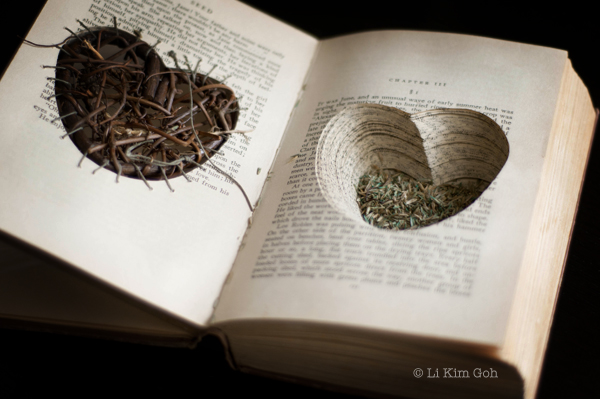
2) Li Kim Goh's Seed (2011). More images and info at her website, here.

Monday, January 16, 2012

Jody Alexander's Exposed Spines (2010), here. Alexander's version of The Handmaid's Tale here, more work here, and her website here.

Tuesday, January 3, 2012

From Jerome Fortin's Solitudes (2011?), "a project where hundreds of books are collected, transformed and arranged into tableaus." More on his website, here.

Thursday, December 15, 2011

Curtis Steiner's Among the Poets (2010), at the Sandy Gallery, here.

& similar folded book work by Katya Marritz, here (and here).

Monday, November 7, 2011

1. LoveEvil (2011), an altered Bible by "Some Guy" -- see more, including a video, here. More work here, and a little commentary here and here.

2. Linda Ekstrom's Homeland (2001), an altered Bible. See more of her wonderful work here.

3. And, of course, Thomas Jefferson's altered Bibles (~1804). Jefferson "removed what he believed to be the original messages of Jesus – leaving what he considered 'corruptions,' including miracles and any suggestions of the supernatural – and pasted the clipped passages into a new compilation," explains the Monticello website, here. More images, here, and some discussion of Jefferson's practice here and here.

Monday, October 3, 2011

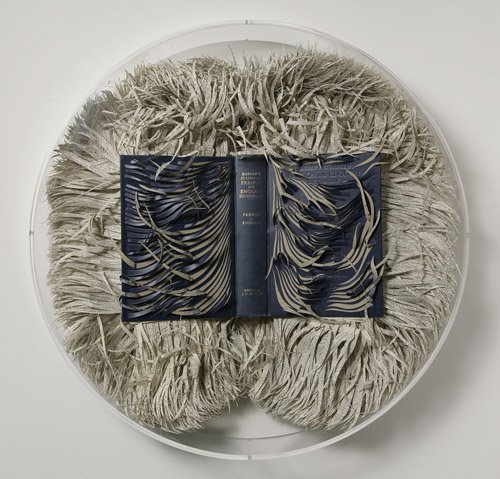
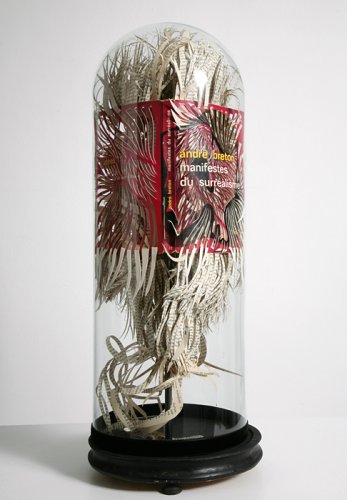
Georgia Russell's Harrap's Standard French-English Dictionary (2009) above and Manifestes du Surrealism (2009), below. According to her bio, here, "There is a simultaneous sense of loss and preservation in each construction, as [Russell] wants to retain and reclaim the past as much as her techniques attack it." Looking for The Bell Jar? See more of Russell's books-under-glass, here, and let me know if you find it.

Link

Tuesday, September 13, 2011


From Nona Orbach's "Sad Maps" series (2010). From Gogol's The Coat (above) and Balzac's Pierta (below). Orbach explains, "My art is related to archeology. I invented a mound called Tel-Nona where I excavate: I am the digger, finds, and museum. Now, my mound is dealing with libraries, calligraphy, and palimpsests." More wonderful work, including "Pocket Dictionary" (2003) on her website, here.


Thursday, August 11, 2011

1) James Joyce's Finnegans Wake (Faber and Faber, 1939).

2) John Cage's Roaratorio: Writing for the Second Time through Finnegans Wake (1978). "I was caught in the Wake. Everything about it is endless and attractive," Cage explains. More here, and we can listen here.

3) Sean Flannagan, "Altering Finnegans Wake" (2006).

4) Nicci Haynes's 226631 Wakewords (2009), here. More from Haynes here.