Showing posts with label whiteout. Show all posts

Sunday, October 5, 2014

E. M. M.'s  A Little White Shadow (Brown & Gross, 1889) 
&
Mary Ruefle's A Little White Shadow (Wave, 2006)

"A Little White Shadow, it turns out, is a book replicating—and containing—another book.... E.M.M. is Emily Malbone Morgan, a writer and philanthropist who wrote and self-published the novella A Little White Shadow, a Christian-themed inspirational tale of a young heiress summering in Italy, to raise money 'for the Benefit of a Summer Home / for Working Girls.'"

      —read the rest of my essay '"Destroying' the Text to Create the Poem" over at Post45. More images of Ruefle's work are here and here. Also, check out Mary Hickman's essay "Defaced/Refaced Books: the Erasure Practices of Mary Ruefle and Jen Bervin" over at Jacket2, here.


Thursday, April 26, 2012


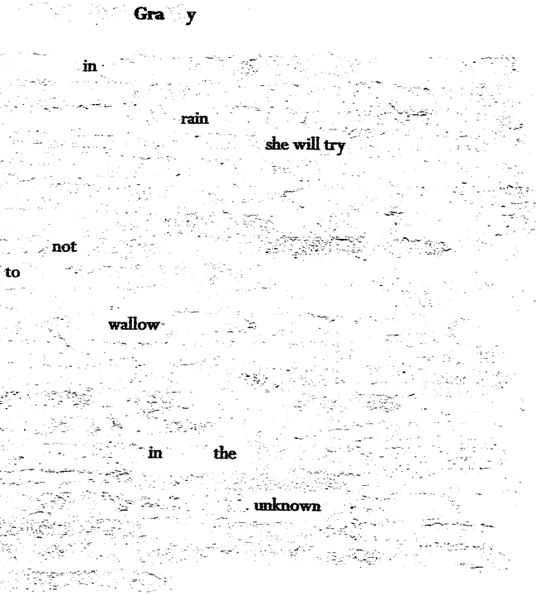
Bradley Harrison's "Gray," the last in a series of erasures of his own poem "Her Problem of Gravity" (2012). Read them all over at The Offending Adam, here. And, with other self-erasures (with white-out!) in his newly released volume Diorama of a People, Burning (Ricochet 2012), here.

Wednesday, March 7, 2012


1) From Sean Bishop's RES--ECTIONS (from Darwin's 1859 The Origin of Species). Bishop explains, "I chose The Origin of Species mostly by accident....It was only after I'd begun erasing that I realized what I was doing: The process of natural selection is itself a form of erasure, after all," at iO: A Journal of New American Poetry, here, as part of a long interview about his chapbook-length erasure project. With more pictures, of course.
2). Ian Monroe's The _____ of _____ By Means of Natural _____ or the _____ of Favoured _____ In The Struggle For Life (2011, a free downloadable e-book, here). Monroe explains, "For the first time, Darwin's dangerous ideas have been published, with every word which doesn't occur in the King James version of the Holy Bible safely redacted."

I begin each page by boxing out interesting pieces of diction or syntax in pencil, then constructing an idea or story from those pieces and whiting out the rest.
I chose The Origin of Species mostly by accident, just because I had an old and beautiful edition of the book gathering dust on my shelf. It was only after I’d begun erasing that I realized what I was doing: The process of natural selection is itself a form of erasure, after all.

Monday, November 7, 2011

1. LoveEvil (2011), an altered Bible by "Some Guy" -- see more, including a video, here. More work here, and a little commentary here and here.

2. Linda Ekstrom's Homeland (2001), an altered Bible. See more of her wonderful work here.

3. And, of course, Thomas Jefferson's altered Bibles (~1804). Jefferson "removed what he believed to be the original messages of Jesus – leaving what he considered 'corruptions,' including miracles and any suggestions of the supernatural – and pasted the clipped passages into a new compilation," explains the Monticello website, here. More images, here, and some discussion of Jefferson's practice here and here.

Tuesday, July 19, 2011


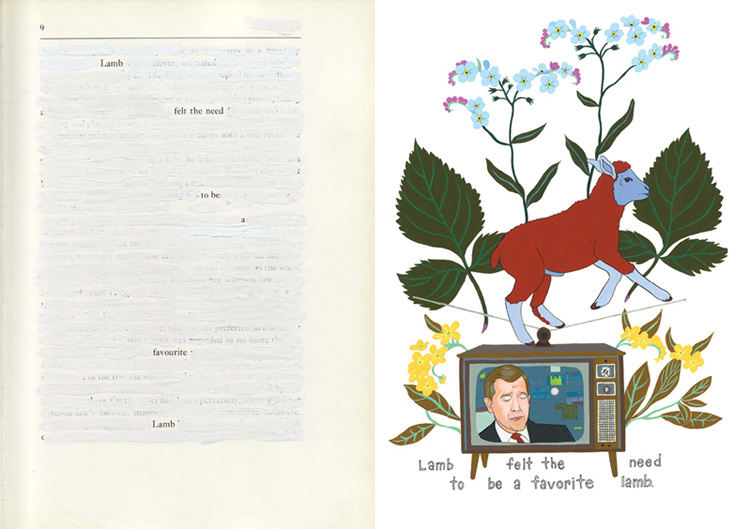
From an "illustrated erasure," Of Lamb, a collaboration between Matthea Harvey and Amy Jean Porter (McSweeney's, 2011). The source text is A Portrait of Charles Lamb, by Lord David Cecil (Constable, 1986?). Harvey explains, "I don't really know how to stop. Essentially it's like having a very pleasurable crossword puzzle with infinite answers," here. More here, here, and here and here. Plus, Oprah likes it!

Thursday, March 31, 2011

Gillian Conoley's modification of Rimbaud's Illuminations, here. From her book, The Plot Genie (Omnidawn, 2009), here. An interview with Conoley here.

Sunday, November 14, 2010


From Doris Cross's altered dictionary, col.umns (San Francisco: Trike, 1982 -- or, at least I think so. Maybe the project began in 1965?). Karl Kempton explains: "the awe begins immediately while viewing, scanning with the eye, then by reading, listening with the ear, then the blending as one learns the language of site and sound, sound and silence, visual image and word image, language as a visually sensual pleasure in itself, the visual image becoming its word, object turned word turned thing come alive by sound. " More here. And here.

Thursday, November 11, 2010


From Yedda Morrison's Darkness (chapter 1), published in 2009, a white-out of the first chapter of Joseph Conrad's Heart of Darkness. You can download or buy it from the publisher, Little Red Leaves, and Morrison's entire book may be forthcoming from Make Now Press. I'll keep my eye out, obviously.

Sunday, October 31, 2010

Why so much white-out?


1. James Yeary's The Cantos (2010?). I don't know much about this--I found it here. And a short essay by Yeary on MacLow, Pound, erasure and a sample poem here.

2. From Mary Ruefle's A Little White Shadow (Wave Books, 2006). Visit Ruefle's website for so many (more beautiful) erasure books. Example.


3. Jen Bervin's The Niagara Book, 2010. More about it here.